


“AI-first” has quickly become the new default.
Organisations are revisiting strategies, redefining operating models, and investing heavily in tools that promise faster, smarter ways of working. A lot of the conversation today focuses on what AI tools to adopt and when to roll them out.
But for most people, the more useful question is:
What does this actually mean for the way I work?
In practice, many teams get stuck before they ever reach an answer. They move quickly to tools, pilots, and platforms – without first understanding where AI would meaningfully help.
The result is often underwhelming pilots, confused users, and solutions that look impressive in demos but feel disconnected from real work.
So for this short series, we’ll follow an AI adoption process – beginning with understanding where work actually breaks, then moving through capibility selection, readiness, solution design and scale. Each article in the series focuses on one step, so teams can apply the thinking incrementally without needing to overhaul everything at once.
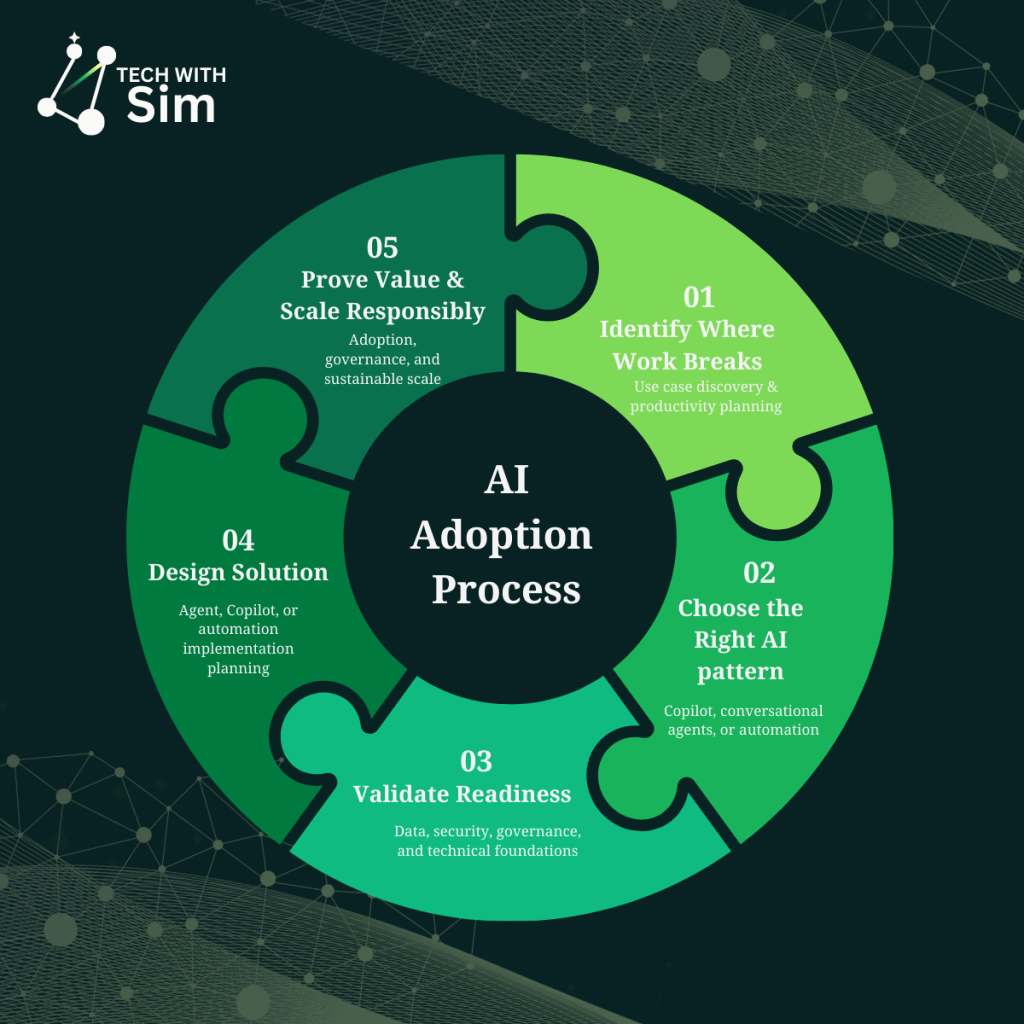
This article focuses on Step 1: Identify Where Work Breaks : identifying the right use cases, before choosing any tools or platforms.
Start Where the Work Actually Breaks
High-value AI opportunities rarely live in shiny, greenfield ideas.
They usually live in everyday friction – the places where work slows down, repeats, or depends on people stitching information together manually.
A useful starting principle is this:
When work relies on people translating, connecting, or recalling information across systems, AI can help reduce the effort involved while keeping judgment and accountability with people.
The goal isn’t to change who makes decisions. It’s to reduce unnecessary effort so people can focus on the decisions that actually matter.
A Practical Framework for Finding AI Opportunities
Instead of asking “Where can we use AI”, a better questions is:
- Where is time being lost?
- Where does work stall?
- Where are people compensating for gaps in process, systems or access to information?
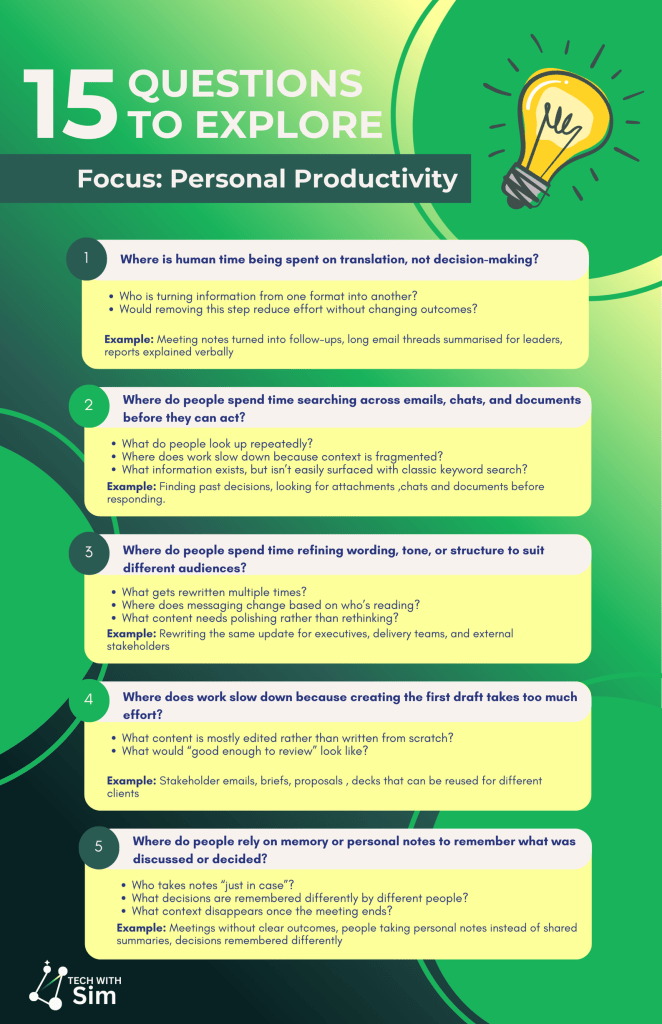
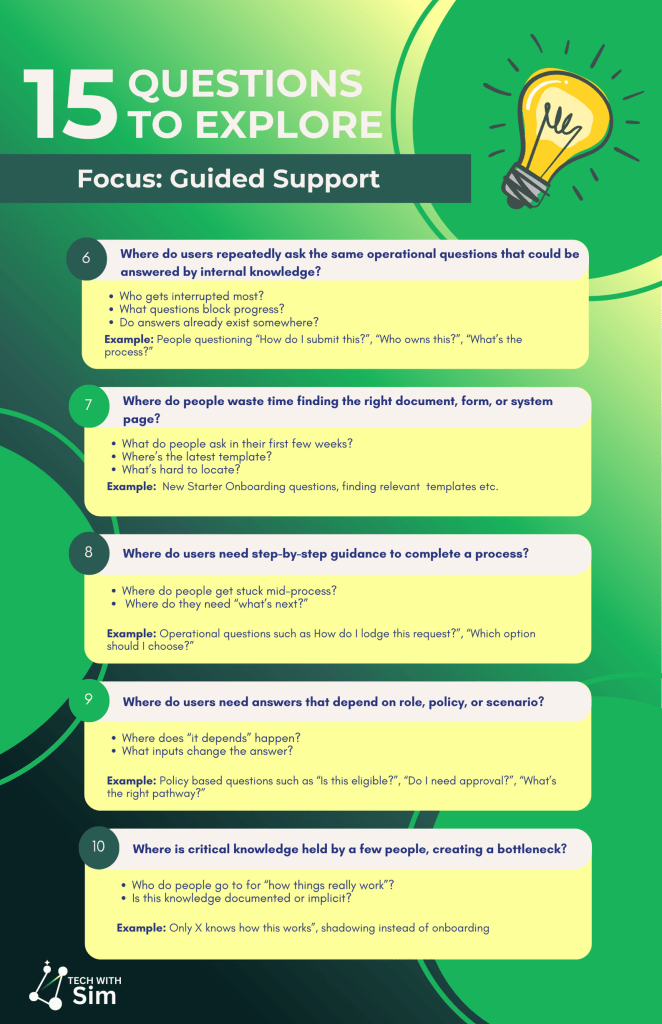
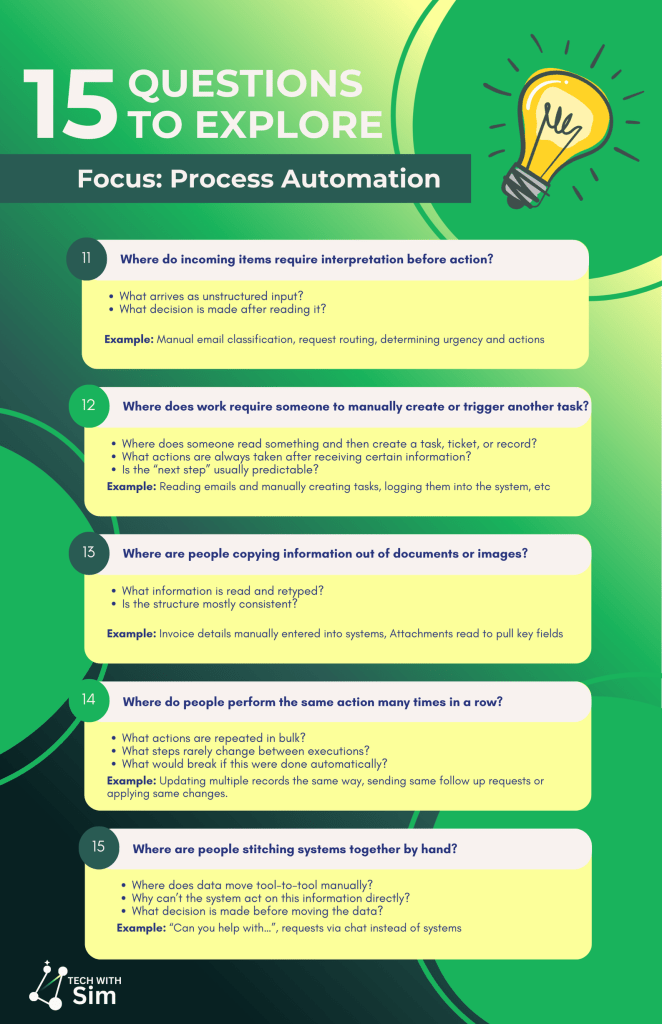
To make this practical, I’ve grouped 15 real-world questions into three lenses that commonly surface strong AI opportunities:
- Personal productivity – where individuals spend time reading, searching, drafting, or summarising
- Guided support – where people need answers, guidance, or context to move forward
- Autonomous / automation-ready work – where tasks follow predictable patterns and could progress without constant human involvement
Refer to the three visuals below to explore these questions and identify which patterns show up most often in your organisation.
You don’t need to answer every question.
You just need to recognise the ones that make you think, “we do that all the time.”
AI vs Process: A Quick Sense Check
Not every inefficient process is a good candidate for AI.
In real delivery environments, teams often mistake process problems for AI opportunities. Disjointed workflows, duplicated data, and unclear ownership can make work feel complex – but that doesn’t necessarily mean intelligence is missing.
Sometimes the right answer isn’t AI at all.
It’s a clearer process, better structure, or a single source of truth.
Before investing in AI, apply this quick sense check:
Fix the process first when:
- data is copied between multiple tools
- there’s no clear system of record
- approvals happen via email or chat
- templates or standards don’t exist
AI is a good fit when:
- inputs arrive as unstructured text (emails, documents, chats)
- decisions require interpretation, not rigid rules
- knowledge doesn’t scale beyond individuals
- partial improvement still delivers meaningful value
What Comes Next
Once you’ve identified the right problems, the next question becomes:
Which AI capabilities are actually designed to solve them?
Microsoft offers several distinct approaches – from productivity Copilots, to knowledge-based agents, to intelligent automation. They’re powerful, but they’re not interchangeable.
In the next article, I’ll break down Step 2: deciding the right AI approach:
- the different types of AI agents in the Microsoft ecosystem
- which tools fit which problems
If you’d like to sense-check your own use cases or apply this framework in practice, I enjoy exchanging ideas with the community feel free to reach out on LinkedIn.
Clarity first. Tools second.

 Tech with Simran
Leave a comment